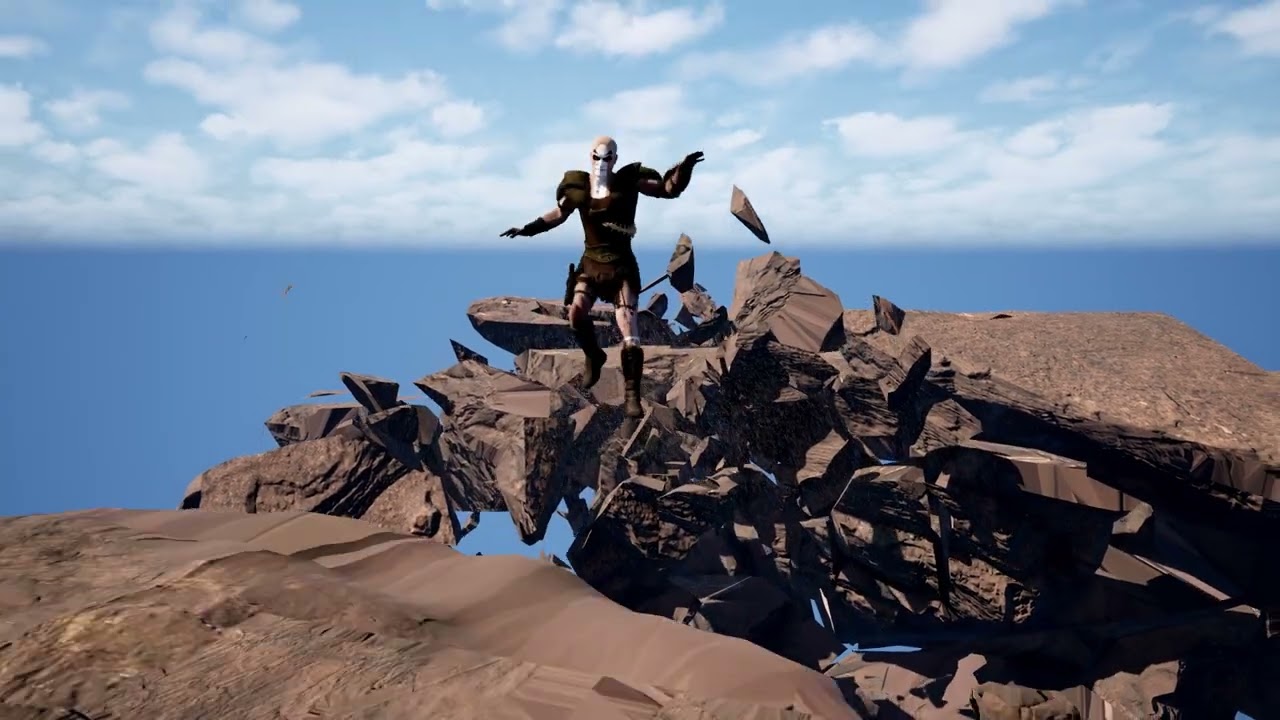
this was assignment 3 for the real-time animation module — create a short animated sequence demonstrating four principles of animation using physically-based systems in unreal engine 5. i chose to tell the story of hanuman’s second flight: the moment jambavan reminds hanuman of his dormant power, and he makes a colossal leap across a cliff gap.
the narrative
the sequence has a clear arc: hesitant slow run → building sprint → wind-up → explosive leap → cliff-shattering landing → slow-motion look-back. every technical decision — physics, particles, camera work — was in service of that story beat.
all character animations were sourced from mixamo and edited inside ue5’s sequencer. three blending approaches were tested before landing on the final one:
- boolean-based blending — switching states via condition flags. too abrupt.
- slot-based blending — inserting animations into named slots in the animation blueprint. better, but limited control.
- overlay blending in sequencer — direct track overlay on the cinematic timeline. smoothest transitions, adopted for the final cut.
a static end-pose was extracted from the penultimate animation using ue5’s pose asset workflow, then converted into a single-frame animation to hold hanuman’s final position cleanly.
four principles of animation
squash and stretch
implemented directly in the jump animation. hanuman squats low (squash) during wind-up, compressing his body, then explosively extends into a full-body stretch at take-off. the positions were manually exaggerated in sequencer to make the principle unmistakably readable. on landing, the chaos cliff geometry shatters at the contact point — reinforcing squash at an environmental scale.
anticipation
the sprint transitions into a deliberate crouch-and-wind-up before the leap. a trimmed crouch animation was blended into the run-to-jump transition using sequencer overlay blending, clearly signalling to the viewer that something powerful is about to happen.
follow through
after hanuman lands, the cliff keeps collapsing and the niagara dust cloud grows progressively — secondary elements extending the energy of the impact well past the moment itself. his slow-motion look-back lets the audience witness the ongoing environmental reaction.
exaggeration
time dilation (slow motion) applied at the peak of the leap amplifies the drama. the sheer scale of the jump — crossing a vast cliff gap — communicates superhuman power. the camera intentionally can’t keep hanuman in frame during his skyward ascent, and the final shot swirls around him as the entire cliff disintegrates into a fog of dust behind him.
physically-based feature 1: chaos destruction
the cliff fracture was the technical centrepiece. rigid body dynamics governs fragment motion:
- F = ma (translational) — net force, mass, linear acceleration
- τ = Iα (rotational) — torque, inertia tensor, angular acceleration
fracture patterns are pre-computed via voronoi decomposition, and fragments detach when accumulated strain exceeds a material threshold. the sleep/wake mechanism suspends simulation of stationary bodies until an external impulse wakes them, keeping CPU cost low until the exact moment of impact.
setup:
- the cliff was converted into a geometry collection using ue5’s fracture mode with a voronoi pattern at medium cluster density — producing large, dramatic fragments
- the collection was placed in sleep state to prevent any premature simulation
- an anchor field pinned the cliff base, directing fracture propagation upward and outward from the impact point
- a second smaller geometry collection on the far cliff handled hanuman’s landing — a smaller, more controlled fracture to reflect his growing mastery
what was tried and discarded: a radial falloff force field was tested to add outward impulse at impact. results were visually unstable — fragments launching at inconsistent velocities, resembling an explosion rather than a structural collapse. relying solely on the character’s contact impulse and gravity was far more believable.
limitation worth noting: voronoi generates geometrically regular fragments. real rock fractures along material grain lines — clustered voronoi with noise offset would better approximate natural breakage.
physically-based feature 2: niagara particle dust
the dust cloud sustained the follow-through long after the cliff impact. particle motion integrates per timestep, and dust behaviour is dominated by viscous drag — a high drag coefficient produces the slow, billowing quality of fine rock dust.
setup:
- a custom dust material colour-matched to the cliff asset, built in ue5’s material editor
- a depthfade node prevents hard intersection edges where particles meet cliff geometry
- particle opacity driven by a particle colour pin for smooth lifetime fade
- spawn rate keyframed in sequencer — inactive until the first impact, then increasing progressively in sync with the cliff’s collapse
two emitter approaches compared:
| approach | result | verdict |
|---|---|---|
| blowing/directional particles | aggressive, wind-blown feel | discarded — disconnected from the collapse |
| growing hanging particles | slow-rising sprites, high drag | adopted — matched real rock dust behaviour |
parameters tuned: drag ~0.8 for slow billowing; curl noise force module for natural swirling; particle lifetime 8–12s with slow fade; scale over life expands particles as they rise. at peak particle count a minor GPU drop was observed — reducing max count and compensating with larger sprites resolved it without visible quality loss.
challenge: without depthfade, particles produced harsh visible intersections with the cliff geometry at specific camera angles — only discovered mid-production, requiring a material fix.
what i learnt
- overlay blending in sequencer is the cleanest tool for cinematic animation in ue5 — far more flexible than driving everything through the animation blueprint
- sleep state + overlap activation for chaos destruction gives precise narrative timing. continuous collision detection with the character controller was too unstable
- depthfade is non-negotiable for any particle effect touching solid geometry
- follow-through can be entirely handled by physics — the environment reacting to the action communicates scale more convincingly than further animating the character
- time dilation is a cinematic cheat that costs almost nothing and pays off enormously for exaggeration moments