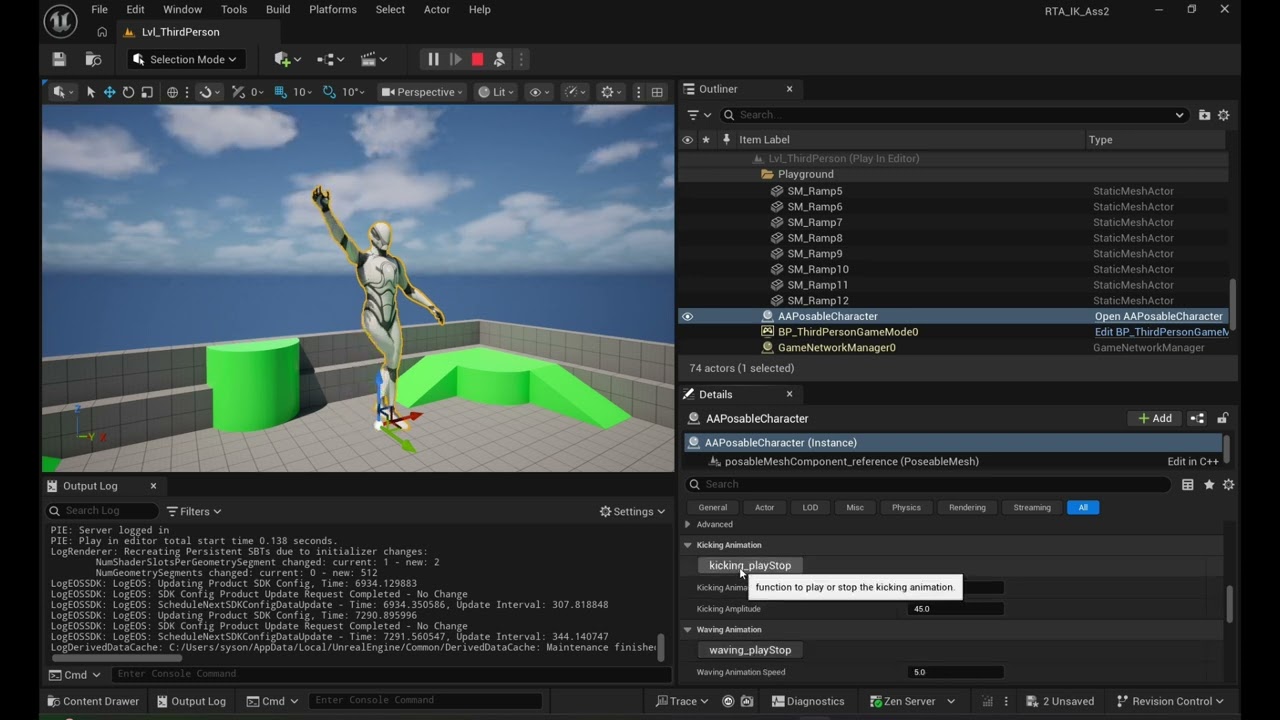
this was an assignment for the real-time animation module at trinity: implement a multi-bone inverse kinematics system from scratch in unreal engine 5 using c++. no built-in ik nodes, no animation blueprint magic — custom solver, custom components.
what it does
a mannequin arm with three bones (upper arm, lower arm, hand) reaches for a moving target in real time. the target moves along a spline path defined by keyframes, and the arm follows it with natural-looking constraints on every joint.
the fabrik algorithm
fabrik (forward and backward reaching inverse kinematics) is an iterative solver. each iteration has two passes:
backward pass — start from the end effector (hand), place it at the target, then walk back towards the root adjusting each bone to maintain its length:
Config.Bones[NumBones - 1].CurrentPosition = TargetPosition;
for (int32 i = NumBones - 2; i >= 0; --i) {
    FVector Direction = (Config.Bones[i].CurrentPosition - Config.Bones[i + 1].CurrentPosition).GetSafeNormal();
    Config.Bones[i].CurrentPosition = Config.Bones[i + 1].CurrentPosition + Direction * Config.Bones[i].BoneLength;
}
forward pass — fix the root in place, then walk forward repositioning bones towards the end effector:
Config.Bones[0].CurrentPosition = RootPosition;
for (int32 i = 1; i < NumBones; ++i) {
    FVector Direction = (Config.Bones[i].CurrentPosition - Config.Bones[i - 1].CurrentPosition).GetSafeNormal();
    Config.Bones[i].CurrentPosition = Config.Bones[i - 1].CurrentPosition + Direction * Config.Bones[i - 1].BoneLength;
}
repeating these passes until convergence (or max iterations) produces the final joint positions. the elegance is that bone lengths are preserved exactly — no drift, no stretching.
applying rotations to the skeletal mesh
fabrik gives you positions, but ue5’s poseable mesh needs rotations. the conversion uses FQuat::FindBetweenNormals to compute the delta rotation between the current bone direction and the target direction:
FQuat DeltaRot    = FQuat::FindBetweenNormals(CurrentBoneDir, TargetDir);
FQuat NewWorldQuat = DeltaRot * CurrentWorldQuat;
PoseableMesh->SetBoneRotationByName(
    Config.Bones[i].BoneName,
    NewWorldQuat.Rotator(),
    EBoneSpaces::WorldSpace
);
joint constraints
without constraints, fabrik produces correct positions but can result in unnatural configurations — elbows bending backward, shoulders over-rotating. joint limits clamp each rotation to a realistic range:
- shoulder: ±90°
- elbow: constrained to forward-bending range only
- wrist: smaller range
unreachable targets
if the target is further than the total arm length, the solver clamps it to the maximum reachable point. this prevents the arm from stretching/distorting:
float totalLength = /* sum of all bone lengths */;
if (FVector::Dist(RootPosition, TargetPosition) > totalLength) {
    TargetPosition = RootPosition + (TargetPosition - RootPosition).GetSafeNormal() * totalLength;
}
spline-driven scripted animation
the target moves along a spline path using catmull-rom interpolation between keyframes:
FVector CatmullRomInterpolate(const FVector& P0, const FVector& P1,
                               const FVector& P2, const FVector& P3, float T) {
    float T2 = T * T, T3 = T2 * T;
    return 0.5f * (
        2.0f * P1 +
        (-P0 + P2) * T +
        (2.0f * P0 - 5.0f * P1 + 4.0f * P2 - P3) * T2 +
        (-P0 + 3.0f * P1 - 3.0f * P2 + P3) * T3
    );
}
catmull-rom passes through every control point (unlike bezier) which makes it easier to define exact positions the arm needs to reach. a smoothstep ease-in/out function on T removes the abrupt acceleration at keyframe transitions.
modular architecture
the system is split into four components:
IKComponent— manages IK solving and target updatesIKChainSolver— the FABRIK algorithm itselfSplineAnimationComponent— generates the moving target positionAAPosableCharacter— wires everything together
this separation means the ik solver can be reused on any character by attaching IKComponent without touching the animation or spline code.
what i learnt
- fabrik is a surprisingly elegant algorithm. the two-pass structure is easy to reason about and debug — you can print intermediate bone positions and see exactly where it’s going
- quaternions in ue5 (
FQuat) are the right tool everywhere rotations appear.FindBetweenNormalsin particular is a clean way to express “rotate from this direction to that direction” - joint constraints are harder than the solver itself. getting realistic-looking limits requires experimentation, not math
- catmull-rom is strictly better than linear lerp for spline paths in animation. the tangent continuity at control points eliminates visible direction changes
- the ik → spline broadcast pattern (spline broadcasts position, ik reads it every frame) is a clean decoupled architecture — changing the animation path doesn’t require touching the ik code at all